
Featured Purchase Your Heritage Pass

The year 2027 marks the 1,000-year anniversary of the birth of William the Conqueror, Duke of Normandy and King of England. Communities across Europe are celebrating their Norman heritage, language and traditions. Join us for a special programme of Norman-themed events, exhibitions and activities.
The Norman Channel Islands
The Channel Islands became part of Normandy in 933, when William Longsword, son of the Viking Rollo, extended Norman territory into the Channel Islands. Norman influence grew over the following centuries and shaped the Islands’ language, laws and place names. Many surviving buildings, including parish churches, Mont Orgueil Castle and Grosnez Castle, were partially built in Norman style.
The Channel Islands and 1066
The Battle of Hastings in 1066 reset the history of England and the Channel Islands.
On this momentous day in October 1066, the last Anglo‑Saxon King of England, Harold, fought William, Duke of Normandy, in what was to become known as The Battle of Hastings. After a full day of fierce combat, William’s army was victorious. On 25 December 1066, William was crowned King of England at Westminster Abbey. His feat earned him the title of ‘The Conqueror’.
Notre Duc
As well as becoming King of England, William retained the title of Duke of Normandy.
In 1106, William’s youngest son, Henry I, seized the Duchy of Normandy from his brother, Robert; since that time, the English and subsequently British Sovereign has also held the title Duke of Normandy.
By 1205, England had lost most of its French lands, including Normandy. However, the Channel Islands, part of the lost Duchy, remained a self-governing possession of the English Crown.
The Islands today owe allegiance to the Sovereign in their role as Duke of Normandy. Islanders toast ‘Le Roi, Notre Duc’ in recognition of this role.
Jersey Museum / 12.30am to 1.30pm / The first Wednesday of the month from 6 January to 1 December 2027
FREE to attend
As part of our Year of the Normans 2027 programme, listen to our Jèrriais Language Officer, Geraint Jennings, read aloud in Jèrriais from the 12th-century works of Wace. Find out more.

Maritime Museum / 10am to 4pm / Monday to Friday, 8 to 12 February 2027
The stormin’ Normans conquer the Maritime Museum during February half term to transport you back to the famous Battle of Hastings, keep reading for more.

Elizabeth Castle / 16 July to 31 October 2027
How did a sixth-century hermit’s shrine grow into one of the most important religious institutions linking Jersey to Normandy, England and medieval Europe? Find out more.
Supported by: Government of Jersey and Creative Island Partnership

Mont Orgueil / 16 August to 31 October 2027
The Tudor Hall at Mont Orgueil is filled with tiny toy soldiers and horses to recreate the famous Battle of Hastings. Designed by Jean-Paul Turquois, a Playmobil enthusiast, keep reading to find out more.
Supported by: Government of Jersey and Creative Island Partnership

Jersey Museum / 5 October to 31 December 2027
This exhibition showcases early photographs taken by the family and circle of Victor Hugo. Find out more.

Hamptonne / Saturday and Sunday, 16-17 October 2027 / 10am to 5pm
Experience one of Jersey’s most cherished rural Norman traditions – the cider-making process, from orchard to barrel. Find out more.

Explore Jersey’s Norman heritage as we look ahead to 2027 when we mark 1,000 years since the birth of William the Conqueror. In this episode, we journey back to our Norman roots through the Island’s Norman history and explore how that history has shaped our Island.
Hosts Mel and Perry are joined by historian Jean Treleven, who guides us through the history of how our Norman heritage is what uniquely defined us then, but also defines us now. Jean shares in-depth insights and fascinating facts as we prepare for one of the most significant commemorations in our Island’s story.

Jèrriais has been the traditional language of legends, poems, neighbourhood gossip and fireside-tales in Jersey for more than 1,000 years. It is an important part of the living linguistic heritage of the British Isles and remains a unique expression of our identity and culture.
Many Jèrriais words, particularly those connected with the sea and farming, come from the Norse-speaking Vikings who settled in Normandy and the Channel Islands. Jèrriais shares its origins with the language once spoken by William the Conqueror and with Anglo-Norman, the language used in Britain for several centuries after the Norman Conquest.
Jersey’s geographical location and relative independence allowed Jèrriais to develop in its own distinctive way, creating a form of speech that belongs to us alone. Like all living languages it continues to evolve with new words added over time to describe modern life. Therefore, although it is under increasing pressure from the growth of English, Jèrriais remains relevant in the 21st century.
Today, there is growing interest in Jèrriais, both in Jersey and around the world. More people are discovering the language, learning it and exploring its rich Norman heritage.
As part of our ‘Year of the Normans’ celebrations in 2027, our Education team have trialled a workshop about the Normans, linking the history, language and evidence with the craft skills of embroidery.
Thank you to St John’s School for working with us to develop this programme – students at the school were given the opportunity to learn about Jersey’s links to the Normans, design their own mythical creatures for the margins of the panels of our community project, the Jersey Bayeux Tapestry, and try their hand at the same embroidery stitches used on the Bayeux Tapestry itself!
The Normans workshop is now ready for more schools to take part. It is aimed at Years 4-6 and also has opportunities for secondary school age. It comprises of two in-school sessions, it is free and we supply all the materials needed. If you’re a teacher and it sounds like something you would be interested in for your school, please get in touch using the link below.

The origins of Jersey’s legal system are based on Norman Customary Law. These were a set of laws that developed in the Duchy of Normandy between the 10th and 13th centuries.
In England, Magna Carta (‘Great Charter’) enshrines the principle that all people, from Kings to Commoners, have an equal right to justice and that no individual is above the law: “To no one will we sell, to no one deny or delay right or justice.”
These powerful concepts of equality across all backgrounds and the right for all to a fair legal process are ones that many individuals and countries still strive to achieve today, over 800 years after Magna Carta was signed.
In Jersey, Magna Carta had no direct legal effect but through the laws and customs of Normandy, Islanders had the right to demand those same fundamental concepts of equality and justice.
Shortly after Magna Carta was negotiated, King John died leaving a young child, Henry III, as his heir. In February 1218, the Regency Council, acting on behalf of Henry, issued a mandate to Philippe d’Aubigny as Warden of the Isles. The mandate declared that the Assizes, which included court procedures, established in the time of King John and his two predecessors as Dukes of Normandy should be observed. The Assizes included reference to Norman Customary Law, which was confirmed in the Channel Islands.
In the first decades of the 13th century, there were two written versions of the Customary Law in existence. The first was the Très Ancien Coutumier dating from c.1200 and a little later the Grand Coutumier.
In the description of the Grand Coutumier, we can start to see some of the concepts enshrined in Magna Carta. It is established as the laws and statutes of the rulers of Normandy “for the welfare of humankind”. Through this statement, we can see a desire for the laws to benefit all individuals, not just the higher ranks of society, echoing Magna Carta’s concept of justice for all.
The document also looks at the role of the Vicomte. The Vicomte was the local administrator of justice and in Jersey, we still have a Viscount as part of our legal establishment.
The medieval role is key in ensuring that individuals are not arrested or held without evidence. The Vicomte was only allowed to imprison individuals after hearing the oath of several witnesses who should be “worthy of credence not suspicion”.
Like Magna Carta, the Customary Law sought to ensure the ruler could not abuse their powers by imprisoning individuals without credible witnesses and evidence. Those who were imprisoned were held until a public inquest or trial took place or released by the law of the land.
A comparison of the Grand Coutumier and Magna Carta shows that Norman law in the early 13th century was giving many sections of society in Normandy access to a legal process, which, if adhered to, would prevent abuses by the ruler and give individuals the right to a fair and equal legal process.
Medieval charters form the written basis of our rights, privileges and freedoms. They underpin and have echoes in documents such as the American Bill of Rights and the Universal Declaration of Human Rights.
In the 1330s, King Edward III established a claim to the Crown of France and the Islands were important to him in pursuing his claim. The King granted charters to Guernsey in 1340 and to Jersey in 1341 that confirmed Islanders’ privileges.
These documents began a series of confirmatory charters granted by the King’s successors, very often at the beginning of a new reign. These reiterated the rights, liberties and privileges enjoyed under the King’s predecessors.
The effect of these charters was summarised by Colonel John Le Couteur in his evidence to the Commissioners Appointed to Enquire into the Civil, Municipal and Ecclesiastical Laws of the Island of Jersey in 1859. Colonel Le Couteur had served as a Jurat and Viscount and had been closely involved in preparing a case on behalf of the Bailiwicks of Jersey and Guernsey to protect the Islands’ freedom to import grain into England.
He told the Commissioners that the charter was the foundation of the liberties of the Island. He said: “No country, not even England, has enjoyed so much freedom as Jersey.”
At the core of this freedom was the confirmation in the 13th century of the continuation of the Norman Customary Law after the separation of the Islands from Normandy.
The Jersey charters and letters patent cover a wide variety of subjects, such as the granting and confirmation of privileges to the Island, appointments, trading rights, disputes, education, inventions, land and pardons.
With thanks to Christopher Scholefield and Charles Thacker for their research into the Jersey charters.
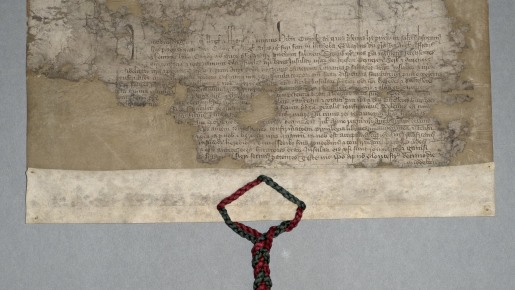
Charter of confirmation by Richard II of the Edward II Charter granting privileges to Jersey, 1378

The 'Jersey Bayeux Tapestry' is an extraordinary modern retelling of the story of the Norman Conquest. We're working with volunteers to learn medieval stitches and create a new tapestry to share stories drawn from the Island’s Norman history, with a focus on the women of the period. Primary schoolchildren are designing mythical creatures to feature in the border of each of the nine panels and these designs will be stitched by secondary school pupils. Throughout early 2027, you can see volunteers working on the tapestry panels at Jersey Museum and the finished tapestry will go on display at the Museum in 2028. This project is sponsored by the Government of Jersey's Creative Island Partnership. Listen to our podcast about the 'Jersey Bayeux Tapestry' using the link below.
Listen to the podcast


Norman, a man from the North, or any Frenchman
This surname was first recorded as Normant and Normanus in the 12th century and other early variations include Le Norman, Normand and Le Normand. The census records for the Island show people with this surname living in most of the parishes.
de Carteret, from the town of Carteret on the Normandy coast
There is evidence of branches of this ancient Norman family holding lands in Jersey from the 12th century and the name has been spelt in various ways, including Carteray, Chartrai, de Kertret and de Cartheret. St Ouen’s Manor was built by the family and remains under the ownership of the de Carteret family to this day. The census records of the mid-19th century show the family residing in the more western parishes of the Island, including St Ouen and St Peter.
Le Sueur, meaning ‘the shoemaker’
It is believed to be a very old name from Normandy in France, with the earliest records of the name in Jersey dating from the Rolls of the Assizes in 1309. Earlier versions of the name include Le Suour, Le Suor and Le Sour.
Census records show family branches living predominantly in the parishes of St Helier and Trinity in the mid-19th century.
de Gruchy, taken from a hamlet called Gruchy in the Contentin peninsula in Normandy
It was recorded as de Groceio in 1089. There have been many other variations of the name, including de Grochee, Grouchy, and Grouchie. It is common to find branches that have dropped the ‘de’ from the name and are just called Gruchy, however it seems likely that they were originally all from the one family. Census records show the name was prevalent in the parish of Trinity.
Le Quesne, from Jersey Norman French word ‘Lé Tchêne’, meaning one who lived near an oak.
This surname was written as Le Kenne in the early 14th century and had other variants, including Chêne and Chaine. Census records of 1851 and 1861 show the name was most prevalent in the parishes of St John, St Helier and Trinity.
Coutanche, derived from the Island’s ties with the Bishop of Coutances
Coutances is a town on the Cotentin peninsular of Normandy, France. The Coutanche name is not recorded in Jersey until the 16th century in the Extente of 1528, where it is written as Coustances. It has also been recorded as Coutances and Constance.
De la Haye, named after the towns in France of La Haye du Puits in Normandy and La Haye Pesnel near Granville, which are named after ‘haie’, meaning hedge
It is one of the oldest Jersey surnames, first recorded in the 12th century as de Haya. Other variants of the name include La Haye, delahaye and de la Haie.
Census records show that this family originally settled predominantly in the parishes of Trinity and St Helier. A number of de la Hayes emigrated to new colonies such as Australia.
Perchard, a man from Perche in the South of Normandy
This surname is recorded on the Assize Roll of 1309 and older variations of the name include Pechard, Perchart and Le Perchand. Census records from the mid-19th century show people with this surname living in various parishes, but particularly the parish of St Martin. Many of the Perchards were, and still are, involved with cattle and farming.