
Featured Purchase Your Heritage Pass

According to legend, Saint Helier was martyred in 555AD on 16th July. To mark this occasion an annual pilgrimage takes place.
Each year, around the 16 July, a pilgrimage takes place, walking across the causeway at low tide to mark Saint Helier who was martyred on this day in 555AD. The pilgrimage is taken on the nearest Sunday to the Saint’s day itself, to lay a wreath on Saint Helier’s Bed, the rocky recess inside the Hermitage chapel that according to belief was the saint’s shelter during his years of devotion and prayer.
The Hermitage had been an attraction for pilgrims in the Middle Ages, and monks from the monastery situated on L’Islet (where Elizabeth Castle was later constructed) showed pious visitors red marks on the rocks which were claimed to be the stains of the martyr’s blood. By the beginning of the 20th century, formal pilgrimages were long abandoned and the details of the life of the patron saint a mere topic of antiquarian interest.

Climbing to the Hermitage to lay the wreath in 2007
Samuel Falle, Dean of Jersey and Rector of Saint Helier 1906-1937, in 1921 revived the mediaeval tradition of pilgrimage to the Hermitage.
Dean Falle set about making the story of Saint Helier better known to his parishioners and all Islanders through sermons and actions. He initiated a community event to improve knowledge and understanding of the man he described as Jersey’s patron saint.
The first of Dean Falle’s revived pilgrimages took place in 1921, but in terms of publicity the event was overshadowed by the visit of the King and Queen which filled the newspapers. On Saint Helier Day in 1922, which fell on a Sunday, the Dean led members of his congregation and elder school children to the Hermitage and held a service in the barracks square.
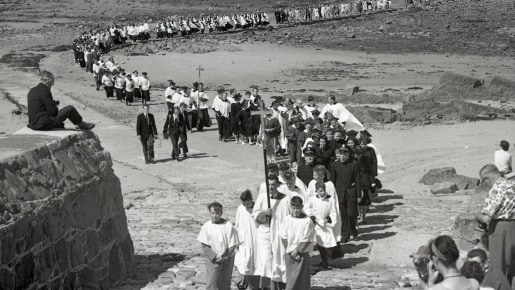
JEP The pilgrimage procession on the causeway to Elizabeth Castle and the Hermitage in 1962 - Image from Jersey Evening Post
In May 1923 Elizabeth Castle was handed over to the States of Jersey and, as a result, controversy broke out in the newspapers over the pilgrimage. It was reported that the Public Works Committee had intended to charge the 250 pilgrims 6d a head for entrance to the Castle to hold the service which was already, in its third year, an established tradition. The Evening Post described the Committee as exploiting a saint for commercial purposes and accused them of wanting their pound of flesh. The newspaper reported the congregation as scrambling over the rocks and through the pools to get to the Hermitage without passing the Castle ticket booth. The service was held at the foot of the Hermitage, with Mr Gerard, the light attendant of the breakwater, baling out as many of the rock pools as he could for the benefit of those attending the service.
The misunderstanding over the entrance charge was swiftly sorted out however, and by 1926 the pilgrimage had become a successful regular event. That year, the date was shifted to 25th July to accommodate the visit of the Bishop of Winchester. Up to 900 people attended the pilgrimage that year, including the Lieutenant-Governor, and they heard the Bishop make an improbably political address on the green at the foot of the Hermitage. 1926 was the year of the General Strike in Britain and, at the time of the pilgrimage, the miners were still on strike. The Bishop told the pilgrims that they were in grave danger from worse pirates than was Saint Helier. One of these pirates, he said, was industrial strife which could affect the future prosperity of the Empire.

Pilgrimage crossing the causeway in 2008
As both a civic and an ecumenical religious occasion, the pilgrimage is open to all and whether one’s mind is on the saint’s isolation on his rock or the castle that was later built, it is a journey that can be enjoyed today by everyone, especially thanks to Dean Falle and his inspiration of 1921
Visit a fortress just off the coast of Jersey to explore 400 years of history.
Find out more

History
Claude Cahun (1894-1954) was an artist, photographer and writer, best known today for surreal self-portrait photographs.

History
The Société Jersiaise excavated the mound at La Hougue Bie during September 1924 and discovered the passage grave beneath.

History
Although it is very small, just nine miles by five, Jersey has an incredibly rich history and heritage of myths and legends.