
Featured Purchase Your Heritage Pass
Jersey’s relationship with the Crown is unlike anywhere in the United Kingdom.
Jersey and Guernsey (Financial Provisions) Act 1947
In 1947, a quiet but significant shift occurred in Jersey’s constitutional story. King George VI, the Queen’s father, placed the hereditary revenues of the Crown derived in Jersey at the disposal of the British Government on the understanding that Jersey would itself fund the Lieutenant-Governor and Crown Officers, while any such revenues received in London would be paid back to the States of Jersey to meet those costs. This gift came with a simple request: that the Islands use these funds to maintain the honour and dignity of the Crown. Net revenues collected locally by the Receiver General have been remitted annually ever since. The arrangement, given effect by statute in both Jersey and the UK, marked one of the earliest modern acknowledgements that the Crown’s financial relationship with Jersey was distinct and exercised in the Island’s own right. By returning control of Crown revenues and financial administration to Jersey, the 1947 settlement laid the groundwork for later developments in taxation, currency, property and governance – each reinforcing the principle that Jersey’s constitutional link to the Sovereign is separate, direct and enduring.
Elizabeth II ascends the throne; Jersey holds its own local proclamation ceremony.
When Elizabeth II ascended the throne in 1952, Jersey held its own proclamation ceremony in the Royal Square, using the standard Accession Proclamation text read across the United Kingdom and Commonwealth. What made the event significant was not the wording, but the context.
By proclaiming the new monarch within its own jurisdiction and registering that act in the Royal Court, Jersey publicly affirmed that allegiance here flows directly to the Sovereign, not through Westminster.
The ceremony was therefore an important early expression, in Elizabeth II’s reign, of the Crown acting in right of the Bailiwick – the same monarch, but a distinct constitutional capacity.

First visit as Queen, 1957, with Prince Philip and Bailiff Sir Alexander Coutanche. Image Jersey Evening Post photo archive.
Currency Notes (Jersey) Law 1959
The story of Jersey’s currency is also the story of how the Crown in right of Jersey became ever more distinct from the Crown in right of the United Kingdom. Before the 19th century, Islanders used French currency, including the livre, sou and liard, which remained common in daily life even after France replaced the livre with the franc in 1795. By the 1830s these coins were worn out and increasingly scarce, prompting the States to adopt sterling as Jersey’s sole legal tender in 1834.
The decisive moment came in 1841, when Jersey issued its first official coinage, struck by the Royal Mint. These coins displayed the monarch’s effigy but were marked with STATES OF JERSEY and denominated in uniquely Jersey fractions of a shilling – a visible declaration that the Sovereign acted here in a different legal capacity from the UK. Every coin expressed a constitutional truth: the same monarch, but not the same Crown.
Banknotes took much longer to reflect this distinction. Through the 19th century, paper money came from parish and private banks, while British notes circulated freely, leaving no need for government‑issued Jersey notes. Only during the German Occupation in 1941, when the Island ran out of money, were emergency notes produced. The modern era began with the Currency Notes (Jersey) Law 1959, placing banknote‑issuing firmly under the Crown in right of Jersey, and the first full series appeared in the 1970s. These notes paired Elizabeth II’s portrait with Jersey’s castles, lighthouses and heritage, rooting the Sovereign’s authority unmistakably in the Island itself.
Together, Jersey’s coins and banknotes chart the emergence of a distinct Crown: local in design, separate in law, and embedded in the daily life of the Bailiwick.
Seignorial Rights (Abolition) Law 1966
Jersey’s relationship with the Crown has never stood still. Even its most ancient institutions have been reshaped rather than preserved untouched. The Seignorial Rights (Abolition) Law 1966 is a clear example: sweeping away feudal powers while retaining the ceremonies that express Jersey’s distinct bond with the Crown.
For centuries, Jersey’s land was organised into fiefs – historic territorial units held directly from the Crown. Their holders, the seigneurs, once exercised real authority, receiving land dues (rentes) and services such as the corvée. These powers ended in 1966 but the titles and traditions survived as part of Jersey’s constitutional identity.
Foremost among these traditions is the Assise d’Héritage, a medieval land court still held twice a year. Here, seigneurs make comparence, formally answering for their fiefs before the Royal Court and affirming loyalty to the Crown. Historically, failure to appear could cost a seigneur their fief; today the ritual endures as one of the oldest surviving expressions of Jersey’s direct relationship with the Sovereign.
The same continuity appears during royal visits, when principal seigneurs still perform acts of homage. These gestures no longer reflect feudal obligation but they do reveal a deeper truth: Jersey modernised its laws without severing the symbolic forms that express the Crown acting in right of the Bailiwick.
In 1966 Jersey did not choose between past and present. It chose both – updating the law while preserving the ceremonies that make our constitutional identity visible.
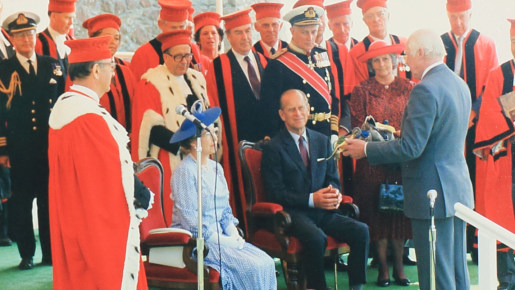
Seigneurs pay comparence at Mont Orgueil, 1989 with Bailiff Sir Peter Crill. Image Jersey Evening Post photo archive.
Jersey flag adoption and proclamation by Elizabeth II (1981)
The modern Flag of Jersey, officially proclaimed by Queen Elizabeth II in 1980 and first hoisted in 1981, brought long‑standing traditions into a single recognised emblem. For generations, Islanders had used an unofficial red saltire on white in a design recorded since at least the 1830s.
Momentum for a redesigned, officially sanctioned flag emerged during the 1977 Silver Jubilee, when celebrations encouraged Islanders to reflect on their constitutional identity and the symbols that represented it.
In 1979, the States approved a new design adding the Island’s historic coat of arms – three gold leopards – surmounted by a Plantagenet crown, expressing Jersey’s medieval privileges and loyalty to the Crown. The completed flag was proclaimed on 10 December 1980 and officially raised on 7 April 1981.
Adopted amid growing public celebration of identity, the flag transformed constitutional ideas into everyday experience. Flown across the Island, it made Jersey’s distinct status and its enduring relationship with the Sovereign visible in modern form.

The Queen’s Visit 1978. Image Jersey Evening Post photo archive.
Elizabeth Castle and Mont Orgueil gifted to the People of Jersey in 1996 & foreshore & seabed in 2015
In the late 20th century, the physical presence of the Crown in Jersey entered a new chapter. Mont Orgueil and Elizabeth Castle, long‑standing symbols of royal authority and protection, had already been managed locally for decades but their legal status still lay with the Crown. That changed on 6 July 1996, when the States of Jersey gathered in an Extraordinary Assembly held in the Middle Ward of Mont Orgueil Castle to formally receive the Crown’s gift of reversionary ownership. At this ceremony, the Lieutenant‑Governor, General Sir Michael Wilkes, acting on behalf of Queen Elizabeth II, handed the keys of both castles to the Bailiff, Sir Philip Bailhache, marking the Crown’s transfer of its remaining interest to the States.
The significance of this moment lay not only in the transfer of two historic fortresses but in what it revealed about the evolving idea of the Crown in Right of the Bailiwick. Where once royal authority had been expressed through garrisons, governors and stone walls, by the 1990s the Crown’s role had become primarily constitutional. The physical symbols of that authority now passed fully into the custody of the Island they had long served to defend.
From this point, Jersey became not only the caretaker but the legal owner of its most iconic castles. The following year, in 1997, responsibility for their long‑term care and interpretation was transferred to the Jersey Heritage Trust through a Deed of Cession of perpetual usufruct ensuring that management rested firmly with local expertise while the public interest remained protected.
Together, the 1996 Extraordinary Assembly and the subsequent transfer to Jersey Heritage illustrate how the Crown’s relationship with Jersey has changed in form but not in continuity. The Crown remains present in the Island’s constitutional fabric, yet the guardianship of the places that once embodied royal power is now firmly rooted in the hands of the Island community.
A further step in this changing relationship came in 2015, when the Crown agreed to transfer all remaining rights and interests in Jersey’s foreshore and seabed to the public of the Island. Confirmed on 25 May 2015, this decision brought the ownership of beaches, tidal zones, and the seabed, long administered locally but still legally Crown‑held, fully into Island hands. Like the earlier transfer of the castles, it showed the Crown’s willingness to recognise Jersey’s capacity to care for the places that shape daily Island life, while maintaining the constitutional bond that defines the Crown in Right of the Bailiwick.
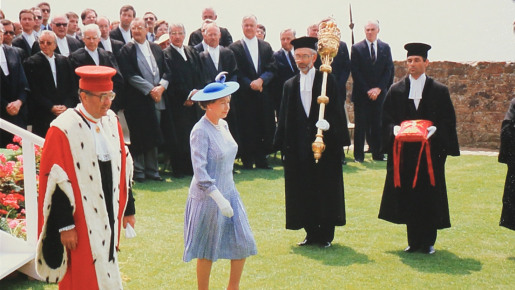
The Queen leaving Mont Orgueil 1989, with Bailiff Sir Peter Crill. Image Jersey Evening Post photo archive.
Jersey’s ancient Crown rights have never been fixed or frozen in time. Rooted in Norman customary law rather than English common law, they evolved as the Island modernised its legal system and clarified how the Crown’s authority should operate within a contemporary jurisdiction. For centuries, some of the oldest prerogatives once exercised on behalf of the Sovereign – rights over treasure trove, wrecks, and the foreshore – were brought before the Royal Court, with Crown officers reporting matters of treasure, abandoned property, or wreckage at the Assise d’Héritage. These were the moments in which medieval custom and royal privilege were publicly affirmed. But rather than disappearing, these rights were gradually reshaped into modern statutory frameworks that preserved their constitutional meaning while changing their form.
This transition is especially clear in the evolution of wreck rights. The Shipping (Jersey) Law 2002 replaced the Crown’s historic prerogative with a statutory system administered locally: all wreck found within Jersey waters must now be reported to the Receiver of Wreck, a Government of Jersey official, and any material that remains unclaimed no longer reverts to the Crown but vests in the Minister responsible. What had once been a feudal right of the monarch became a regulated process rooted in Jersey’s own legislation, updating an ancient practice for a modern, self‑governing Island.
Treasure trove followed a similar path. Once automatically the property of the Crown, it is now managed through the Island’s Heritage (Jersey) Law, which treats treasure as archaeological material requiring expert assessment and public stewardship. Discoveries such as the Le Câtillon II hoard show how these ancient prerogatives endure not by remaining unchanged, but by being absorbed into Jersey’s own legal and heritage systems, where their historical significance is acknowledged even as their administration becomes thoroughly modern.
Across these developments runs a common thread: continuity through change. The Crown’s ancient rights were not abolished; they were translated from prerogatives exercised in a medieval courtroom into powers embedded within contemporary Island law. Their constitutional meaning – tied to the idea of the Crown in Right of the Bailiwick – remains intact, but their operation now reflects Jersey’s own legal processes, institutions, and identity. In this way, the Island’s Norman inheritance continues to shape its present, while the Crown’s role is expressed not through old customs but through the evolving laws of the Bailiwick itself.

Royal visit 2005 with Bailiff Sir Philip Bailhache. Image Jersey Evening Post photo archive.
States of Jersey Law 2005
The early 21st century brought one of the most important shifts in Jersey’s modern constitutional story: a clearer public understanding of how the Crown acts in the Island’s own right. This change took its most visible form in the States of Jersey Law 2005, the first statute to state plainly that Jersey possesses its own autonomous capacity in domestic affairs and an increasing need to engage in international matters. By placing this recognition directly into law, approved by the Crown through the Privy Council, Jersey affirmed that the governmental authority exercised in the Island is not a branch of the UK state but an expression of the Crown in right of the Bailiwick, rooted in Jersey’s own legal and political identity.
The Law did not alter the Crown’s role; instead, it articulated it more clearly. By creating a ministerial system – a Chief Minister and Council of Ministers answerable to the States Assembly – the Island established a modern executive whose authority flows from the Crown specifically as it operates in Jersey, rather than through the Crown in right of the United Kingdom. This strengthened the constitutional distinction already recognised in practice: that Jersey’s government is the Island’s own, and that the Crown’s authority here is exercised on Jersey’s behalf, not through Westminster.
The Law also grounded that authority in democratic accountability, embedding human‑rights obligations and modern governance standards within Jersey’s constitutional framework. In doing so, it reinforced the idea that the Crown’s authority in the Bailiwick is carried by institutions that are themselves rooted in the Island’s electorate and traditions, not in the structures of the UK state.
This clearer articulation of the Crown’s position laid the foundation for the next major step: the 2007 agreement on international representation. Building on the 2005 Law’s recognition that Jersey needed to participate more fully in international affairs, the UK and Jersey agreed that the United Kingdom would represent Jersey externally only on the basis of the Island’s interests as advised by Jersey’s own ministers. This arrangement reflected the same constitutional principle: the Crown acts for Jersey internationally as the Crown in right of the Bailiwick, not by virtue of the UK’s authority over the Island. It was a practical expression of the evolving doctrine that Jersey’s external personality is exercised through the Crown, but informed and directed by the Island’s own government.
Together, these developments mark a significant period in the evolution of the Crown’s role in Jersey. Rather than diminishing the Crown’s place, the 2005 Law and 2007 agreement clarified it – shifting the emphasis from inherited assumptions to a modern, explicitly defined relationship. The Crown remains central to Jersey’s constitutional identity, but the way its authority is expressed has adapted to reflect the Island’s mature institutions: a government operating in the Crown’s name, grounded in Jersey’s own laws, and increasingly active on the international stage as the Crown in right of the Bailiwick.
The Carswell Review of 2010 marked a pivotal moment in clarifying how the Crown’s authority operates within Jersey, and who exercises its constitutional guardianship. Commissioned to examine the roles of the Island’s Crown Officers, the review reaffirmed a central principle of Jersey’s unwritten constitution: that the Bailiff remains not only the Island’s chief justice and civic head, but also the guardian of the constitution, the figure who ensures that the Crown’s authority is properly and impartially upheld within the Bailiwick. Carswell’s examination stressed how deeply rooted the Bailiff’s constitutional function is – bridging the Island’s legal heritage, civic life, and the exercise of Crown authority.
At the same time, the review highlighted the changing dynamic between Jersey’s institutions and the Crown. While some recommendations proposed separating aspects of the Bailiff’s role – such as the suggestion that the States elect their own President – Carswell acknowledged that the Bailiff’s position as civic head was intimately tied to his constitutional role, a link that many Islanders and officials argued should be preserved. The subsequent political debates confirmed the enduring view that the Bailiff remains the Island’s stabilising constitutional figure: the person through whom the Crown’s impartial authority is made visible in public life.
The Carswell Review also coincided with an important shift in how the Crown’s other principal representative, the Lieutenant‑Governor, is appointed. Until 2010, the post was filled by the Crown on the advice of UK ministers, reflecting older assumptions that external oversight of the Island should flow through Whitehall. But in 2010, the system changed: future Lieutenant‑Governors would be recommended to the Crown by a local Jersey panel, typically including the Bailiff, a senior Jurat, and a member of the Jersey Appointments Commission. This shift signalled a major constitutional development. The Crown’s representative in Jersey would still be appointed by the monarch, but now on the advice of the Island itself – a further recognition that the Crown acts in right of the Bailiwick, not through the UK Government.
Together, the Carswell Review and the reformed appointment process illustrate a key theme in Jersey’s constitutional evolution: continuity of the Crown’s authority paired with increased local stewardship of how that authority is expressed. The Bailiff’s role as the guardian of Jersey’s constitutional settlement was reaffirmed, while the Lieutenant‑Governor’s appointment became more rooted in Island processes. These changes show how the Crown’s presence in Jersey adapts over time – not weakened, but reshaped to reflect an Island confident in its own institutions, yet still anchored in the centuries‑old relationship embodied in the Crown in Right of the Bailiwick.
Succession to the Crown (Jersey) Law 2013 & 2022 Proclamation of King Charles III
The Succession to the Crown (Jersey) Law 2013 marked a quiet but decisive moment in Jersey’s constitutional story. For the first time in statute, the Island explicitly defined the Sovereign as holding authority “in right of the Bailiwick of Jersey,” embedding in law what had long existed in practice: that the Crown’s powers here are exercised in a distinct constitutional capacity, not as an extension of the United Kingdom. The Law affirmed that succession to the throne automatically transfers all the rights, powers, and dignities of the Crown as they apply within Jersey, and ensured that every reference to the Sovereign in the Island’s laws refers to the monarch reigning specifically as Jersey’s Duke. This was more than a technical adjustment. It was a codification of centuries of ceremony, custom, and financial autonomy, setting out in precise statutory language what had historically been expressed through oaths, allegiance, and the uninterrupted loyalty of the Island since 1204.
This principle was carried into public life most vividly in September 2022, when Jersey proclaimed His Majesty King Charles III. Unlike the 1952 proclamation of Queen Elizabeth II – read by the Viscount – the 2022 proclamation was delivered by the Bailiff, Sir Timothy Le Cocq, reflecting the Bailiff’s modern role as the Island’s chief civic and constitutional figure. At a special sitting of the States Assembly, the Bailiff formally received and read the Proclamation before it was entered into the rolls of the Royal Court, followed by a public ceremony in the Royal Square and a 21‑gun salute. The shift in who spoke the words was significant: the Island’s constitutional guardian, not a Crown officer of enforcement, now voiced the continuity of the monarchy.
Together, the 2013 Law and the 2022 Proclamation show how the Crown’s authority in Jersey continues in a form both ancient and unmistakably modern. Succession remains automatic, ceremonial life continues with familiar dignity, and the Island maintains its deep allegiance to the monarch. But the expression of that allegiance – in law, in government, and in public ritual – is increasingly shaped by Jersey’s own institutions. The Crown endures as the centre of the Island’s constitutional identity, yet it is the Crown in right of the Bailiwick, interpreted and articulated through the offices and ceremonies of Jersey itself.
The reign of Queen Elizabeth II forms the central arc of Jersey’s modern constitutional history. During her 70 years on the throne, the Island’s relationship with the Crown – rooted in loyalty since 1204 – became clearer in law, richer in symbolism, and more confidently expressed through the Island’s own institutions. Under Elizabeth II, Jersey’s distinct constitutional personality emerged not through rupture, but through quiet, cumulative steps: the return of Crown revenues in 1947; the flourishing of uniquely Jersey currency bearing the Sovereign’s portrait; the Island’s own proclamation of the monarch in 1952; the careful reform of law and landholding; the creation of symbols such as the 1981 flag; the transfer of castles, foreshore and seabed; the modernisation of customary Crown rights; and, ultimately, the statutory articulation of the Crown in right of the Bailiwick in the 21st century.
Through these developments, the Crown’s role in Jersey became more distinct, not less. Elizabeth II’s reign provided the constitutional stability within which Jersey could define its own executive government, participate in international affairs in its own right, and reaffirm the roles of the Bailiff and Lieutenant‑Governor within an evolving constitutional landscape. Far from diminishing the monarchy’s place, these changes clarified it: the Crown’s authority remained central, but its expression increasingly took shape through Jersey’s own laws, officers, and traditions.
This continuity was made visible again in September 2022, when Jersey proclaimed His Majesty King Charles III. The proclamation, voiced by the Bailiff in the Royal Square, echoed centuries‑old rituals while reflecting the modern constitutional reality established during Elizabeth II’s reign. It affirmed that succession transfers seamlessly to the new monarch, and that loyalty in Jersey runs directly to the Sovereign, who reigns here in right of the Bailiwick. The ceremony’s familiar dignity – its gathering of States Members, Royal Court, and public – demonstrated how deeply the Crown remains woven into Jersey’s civic and ceremonial life.
Today, under King Charles III, the Crown continues to provide the constitutional centre around which the Island’s institutions operate. Its future lies not in grand upheavals but in the same pattern that shaped the last century: continuity paired with thoughtful adaptation. Jersey’s government, courts, and civic leaders will continue to act in the name of the Crown; its laws will continue to acknowledge the Sovereign specifically as the Duke of Normandy; and its ceremonies, symbols, and constitutional language will continue to express a relationship that is both ancient and distinct.
As this exhibition has shown, the Crown in right of the Bailiwick of Jersey is not a relic of the medieval past but a living constitutional identity – one that has adapted through finance, law, property, ceremony, and governance while remaining grounded in loyalty, service, and shared history. Under Elizabeth II, this identity was clarified and codified. Under Charles III, it endures, shaped by the Island’s confidence in its own institutions and its enduring bond with the Crown.