
Featured Purchase Your Heritage Pass

The consistently unstable relationship between England and France between the High and Late Middle Ages placed the Island of Jersey, and the rest of the Channel Islands, on the frontlines of a tenuous situation. Following the French conquest of Normandy from 1202-1204, the Channel Islands became a key geo-political position, one from which England could use as a staging position to launch attacks against France and protect their commercial trade with Gascony and Aquitaine. Therefore, it became imperative that England held onto the islands.
Under the reign of King John, Jersey saw the construction of its first castle, Mont Orgueil, which took place around 1204-1205. However, the presence of a new castle on the island did not dissuade from French attack. The geographical position of Mont Orgueil on the east coast left the rest of the island largely unprotected from French raids. Following appeals by the locals for improved protection, King Edward III appointed Sir John des Roches as Warden of the Isles in 1328, with specific instructions to improve the island fortifications, and by around 1330 construction of Grosnez Castle began.
Unlike Mont Orgueil, it is suggested that Grosnez was not built to serve as a conventional castle, but rather specifically as a place of refuge for the inhabitants of Jersey during times of attack. Four suggestions were put forward, by E.T. Nicolle and N.V.L. Rybot (1926), to support this claim. The first point argues that the position of Mont Orgueil, in the far East of Jersey, left the locals who lived in the West, cut off from refuge by attacking forces if they began their approach through the center of the island. The second point argues that Grosnez Castle’s geographical position was out of the way of any strategic port, anchorage or village. The third point argues the presence of a single line of defence and no permanent water supply, which meant that Grosnez Castle was not built to survive a lengthy siege. And the fourth point argues that the castle was built for passive defence only, due to the lack of counter-attacking features, such as sally-ports.

Grosnez Castle: A Reconstruction. Sketch by N.C.L. Rybot. (1926)
This claim by Nicolle and Rybot are by no means an attempt to undermine the importance or elegance of Grosnez Castle. Nicolle and Rybot commend the ‘skillful nature’ of the castle’s position and structure. At first glance Grosnez may seem primitive, with its lack of a natural water supply, sally ports, and secondary defences. Upon closer inspection it becomes clear that its geographical position overlooking the North-West coast of Jersey made it a viable observation post. And from a defensive point of view, the surrounding cliffs acted as a natural defensive barrier, leaving the southern side as the only feasible point of attack, allowing for a small garrison to defend the position. These factors point Nicolle and Rybot to suggest that Grosnez Castle was ‘designed by a military engineer of full experience in the art of medieval warfare.’
Grosnez Castle is also unique in the fact that its stone work was adorned with decorative corbels. Although these stone corbels were not the most elaborate in their design, when compared to that of other stone sculptures of similar date, they do provide a key insight into the ‘realm of art’ in Jersey during the High Middle Ages. These stone corbels are believed to have been positioned within the gated archway of Grosnez Castle, placed in a manner that made them clearly visible to any onlookers, both peaceful and aggressive. Rybot notes that the architect of the castle must have held them in high regard to adorn them in the most important position of the castle.
Despite its praise as an important position to hold, Grosnez Castle’s role as a defensive refuge would be short lived. In 1373, Grosnez Castle was besieged and captured by a French force, led by the Duke of Bourbon. From that point forward, it slowly fell into disrepair, with parts of the castle, including the stone corbels, being dismantled by its occupiers. It is widely believed by around the 1460s, Grosnez Castle became redundant and left to ruin.

Grosnez Castle Gatehouse Reconstruction. By N.V.L. Rybot. (SJA/0000/00032)
Between 1882 and 1896, the Société set their sights on Grosnez Castle, with the intention to conduct archaeological investigations and carry out restoration and consolidation works. A total of three excavations took place with the first lasting from October 1882 to January 1883, the second from November 1895 to January 1896, and the third from September 1896 to December 1896.
The Société elected Colonel C.P. Le Cornu to lead the investigations with the help of three workmen. The initial works involved clearing loose debris and defining the location of the castle wall and other stone structures.
During work on the south side of the archway in 1882, the first two corbels were recovered. Excavations continued in the vicinity of the southern archway with the purpose of uncovering the castle foundations. During this focus, Le Cornu uncovered a further ten corbels, between 1882 and 1896, along with other masonry remains such as arch stones, all within the castle ditch. Le Cornu (1897), noted that the granite used to create the corbels came from Mont Mado, a major quarry site utilized for the extraction of granite. In total, twelve granite corbels were discovered by Le Cornu and his team.
Elsewhere, Le Cornu’s excavations also produced a number of pottery sherds, animal bones, iron fittings, lime and gravel mortar, sea pebbles, and a small French coin.

View of Grosnez Castle Arch before excavation and repair, 1871-1873. (SJPA/001202)
Corbels are decorative support structures, often utilized in the construction of arches, roofs, and walls. Their primary purpose was to support the weight of a structure, but often featured elaborate designs as a way of enhancing the grandeur of a structure. The grander the design, the greater the display of wealth, power, and craftmanship.
In 1926, Major N.V.L Rybot published a report detailing the Grosnez Corbels. He placed the twelve corbels into three categories. Double-Skewback, Single-Skewback, and Flat Tops. The iconography displayed on the front of each corbel features either the figure of a human head or geometrical shapes.
Rybot (1926) ascertained that the creator of these corbels was a low-quality mason, due to the poor representation of the human figures. In comparison to other stone corbels found across Europe, notably in France, the quality and technique is incredibly primitive. Rybot argues that despite their general poor quality, they still found enough favor to be included in the construction of Grosnez Castle by its architect. This offers some insight into Medieval art in Jersey. As some of the only surviving examples of Medieval sculpture, it is clear there was little intention by local architects to decorate their structures with the most elaborate masonry but rather build them simply for purpose only. Rybot (1926) describes this desire as fit for a ‘practical, sturdy, poor, and unimaginative race.’ Despite this, the Grosnez Castle corbels still offer a unique and occasionally comedic look into the artistic nature of local masonry during the Medieval period in Jersey.
Image: Sketch of the 12 Grosnez Castle Corbels. By N.V.L. Rybot (Article 8 – 1926). Numbers and Brackets added to distinguish the different types of corbels.

Of the twelve corbels discovered, six of them featured figures of human heads. Rybot (1926) attempted to identify who each figure was supposed to portray. The two stand out corbels are Corbel 1 and Corbel 9.
Corbel 1 features a crowned head with a forked beard. The presence of a crown can only indicate royalty, and it is likely that this figure is meant to represent King Edward III, who was king during the construction of Grosnez Castle.

Corbel 9 features an elongated face connected to a narrow neck and shoulders, it also bears the remnants of a possible headband or crown above the brow. Although, this is speculative due to the structural damage to the right of the face. Rybot (1926) suggests Corbel 9 to be a portrayal of the then Queen, Philippa of Hainault, Edward III’s wife. It is plausible to suggest that Corbel 1 would have rested directly above Corbel 9 when mounted in the Grosnez archway, as Corbel 9 is a flat back corbel which would have supported the skewback corbels, such as Corbel 1. It is likely that the King would have been positioned above the Queen in this situation.

Corbels 2, 3, & 4 also feature figures of human heads. The figure in Corbel 2 is missing the lower right of its head, due to structural damage. It also appears to be wearing some form of decorative head dressing, although it is unclear as to the exact nature of what it represents. Corbel 3 features a complete circular head with no facial hair or decorative features, and Corbel 4 features a complete circular bearded face with no other decorative features. The identity of these figures is not entirely clear. It is likely that they are meant to represent local Island notables. Rybot (1926) loosely suggests that these corbels are possibly a representation of the Lord of the Manor, the Keeper of the Isles, and his Lieutenant.

Corbel 2 3 and 4
Corbel 5 is believed to not represent a specific person, but is rather a caricature presenting a comedic jeer. It features the figure of a bearded human head, with an extended tongue. The angle of the face is also different to that of the others, with it slanted at an angle. Rybot (1926) likens it to the same kind of witty nature found in French cathedral gargoyles, and its sole purpose was to serve as a mocking gesture towards any would-be attacker.

The other six corbels feature geometric patterns rather than human caricatures. It is not entirely clear what each pattern is supposed to represent, and is entirely possible that these were random carvings.
Some of the corbel patterns point towards religious markings. Corbel 6 features a six-pointed star, similar to that of the Star of David. This hexagram pattern was commonly known amongst Medieval Christians as the Seal of Solomon and was believed to be a symbol of protection. Hexagrams in this style were common within medieval Christian cathedrals and often featured on stained glass windows. Corbel 12 also features the same star, along with a triangular shape with a crucifix. As well as this, Corbel 11 could be a possible representation of St. Andrews Cross, a symbolic representation for the martyrdom of Andrew the Apostle.

The representation of Corbel 7 is unclear. It features the figure of a hand with a faint circular pattern in the center. It is possible that it holds a heraldic representation, serving as a possible sigil. Alternatively, it may also hold a religious significance. Iconography and art featuring hands held significant religious meaning, often signifying a blessing.

The patterns on Corbel 8 and 10 possess limited features, likely due to erosion or structural damage. The surviving features of Corbel 8 include an engraved rectangular shape above a protruding circular bump. Corbel 10 has little to no surviving features apart from a small hook shape on the lower right section. These patterns are of unknown identity and remain up for speculation as to what they might have featured.

Places to Visit
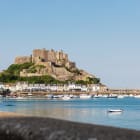
A medieval castle with links to the English Crown and amazing views across to France.

History
We are restoring Elizabeth Castle to ensure it is protected for generations to come

Page
If you have an item of interest you’d like to donate to Jersey Heritage take a look at our collections policy.

Walk
A walk through the ancient lanes of St Ouen to discover medieval manors and a prehistoric monument.