Featured Purchase Your Heritage Pass

Protecting Elizabeth Castle for generations to come
The Castle has many chapters to its story, including residents such as Sir Walter Raleigh, King Charles II and German occupying forces, but its history dates back as far as the 6th century to Saint Helier, who Jersey’s capital is named after. A hermit called Helibert lived in the Hermitage on the islet where the Castle is built. He was murdered and later made into a saint called Saint Helier. Islanders make an annual pilgrimage to the Hermitage and it is a fascinating part of the Castle grounds for visitors to explore.
The first building on the islet was an abbey, named after Helibert and founded in 1155. It was soon downgraded to a priory and later abandoned. Fast forward to the late 16th century and a fortress was being built, taking over the main defence of Jersey once gunpowder and cannon were introduced and the medieval castle of Mont Orgueil on the east coast was no longer up to the job. Raleigh, who was Governor of Jersey from 1600-1603, later named the new castle after his Queen; Fort Isabella Bellissima, or Elizabeth Castle.
The Castle protected St Helier and offered a safe anchorage for merchant vessels, and also gave refuge to Charles II – the Prince of Wales at the time – in 1645 during the English Civil War. It was extended throughout the 17th and 18th centuries and continued to be a military garrison until 1923, when it was sold by the British Government to the States of Jersey. Most recently, the Castle was re-fortified by German forces during the Second World War.
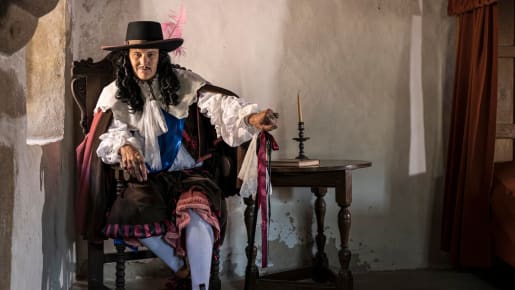
Living history at the Castle includes King Charles II
Today, Jersey Heritage looks after Elizabeth Castle on behalf of the people of Jersey and the Island’s government provided us with vital funding to invest in a major, long-term restoration project, which is the latest chapter in the fortress’ history.
There are more than 30 historic buildings in the grounds of the Castle and, although general conservation work to maintain the site as a whole is ongoing, some of the key buildings need more help – this is where the restoration project comes in.
Phase One of the project was recently completed and focused on the Military Hospital and Coal Store, and the 18th century Officers’ Quarters. Planning permission was granted for both of these projects and preliminary work included gathering essential conservation information for the restoration process.
Built in 1735, the Officers’ Quarters was previously used by Jersey Heritage as an exhibition space. The building, which faces into the Parade Ground at the heart of the Castle’s grounds, was restored and developed. Now reopened, it has been returned to its original use as accommodation and provides opportunities for the Castle to be used in different ways, including by groups during the winter months when the Castle is closed to visitors.

The Castle and all its buildings. Image thanks to Bam Perspectives.
The Military Hospital dates from the early 19th century and is one of the first buildings that visitors see when they enter the Castle. Before the restoration project, our knowledgeable Tour Guides stopped here to share some of the Hospital’s fascinating history but the building was too dangerous to allow visitors access.
Now restored, the Hospital is open for the first time in decades for visitors to explore. Watch the video below and take a virtual tour of the Military Hospital with our knowledgeable Volunteer tour guide Sue Corbel to see how it looked before the restoration work.
The large 19th century Coal Store by the Hospital was unused before the project began. It was refurbished to create a multi-purpose space, with toilet and kitchen facilities. It provides a location for meetings and events, and adds another facet to the Castle.
Now that Phase One is complete, this iconic Castle has entered its next chapter and it remains an integral part of the Island’s story.
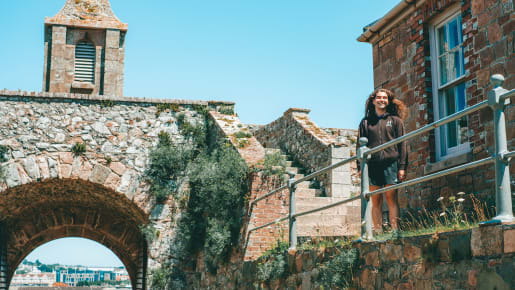
The entrance to Elizabeth Castle
Visit a fortress just off the coast of Jersey to explore 400 years of history.
Find out more