Featured Purchase Your Heritage Pass
Sarah Louisa Kilpack was an artist in the second half of the 19th century who found a great deal of inspiration for her art in the Channel Islands, particularly in Jersey
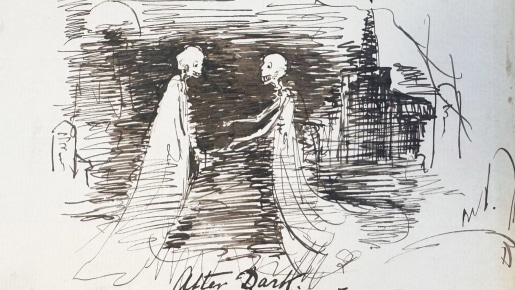
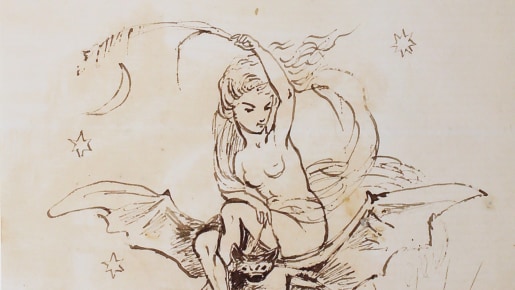
She is best remembered for her Romantic-style coastal paintings, but we also have a number of whimsical ink sketches by Kilpack in our collection, often humorous, and depicting all manner of subjects from folklore to animals.
Kilpack was born in London on 15 December 1839, the youngest child of Thomas and Georgina Kilpack. Thomas Kilpack, formerly a bookseller, ran a tobacconists shop in Covent Garden, below the family’s living quarters on King Street.
Sarah Kilpack was said to have been a shy and sensitive child, with a natural aptitude for both music and drawing. She became a scholar at the Royal Academy of Music and at the age of just eleven, played a Beethoven sonata on piano at a concert at the Old St James’ Hall, near Piccadilly Circus. As the years went on, she played in concerts with increasing frequency, while also providing piano tuition. The income from her music career allowed her to travel out of London to sketch.
In 1863, Kilpack’s mother suddenly died, with two of her half-brothers and sisters following within a few months. Life suddenly became more challenging for the remaining family, and it was probably around this time that Kilpack started to visit the Channel Islands, as a place to escape and to develop her painting techniques.
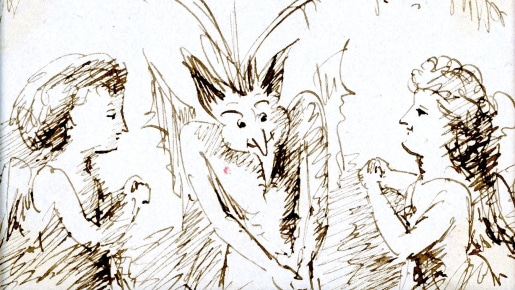
Kilpack’s oldest half-sister, Letitia Kilpack, had married Thomas Brooks in 1844 and soon after moved from London to Jersey, where they resided at Tamworth Villas near Colomberie. Surviving correspondences show that Kilpack and Letitia were close, and therefore it seems likely that the artist may have stayed with her half-sister’s family during her visits to the Island. One of the albums of Kilpack’s sketches in our collection was pasted together by Letitia, from sketches sent in correspondences over a period of several years.
In 1867, one of Kilpack’s Guernsey paintings was exhibited at the eleventh Annual Exhibition of the Society of Female Artists at a gallery in Conduit Street in Mayfair, and two more were hung at the final exhibition of the British Institution. The British Institution stood second in importance to the Royal Academy for exhibitors of paintings in oils, but the institution was disbanded in 1867. Kilpack exhibited at the Society of Female Artists every year for the rest of her life, except in 1876 when her father died. At this point, she moved to 9 Bedford Square in London and abandoned her music career, concentrating instead on her art.
When she moved to Merton Road in the early 1880s, Kilpack enjoyed the best years of her life and was reportedly earning around £500 a year from her painting. She focused particularly on marine landscapes, which often featured stormy skies, rough seas and small human figures, emphasising the enormity of nature compared to people. It is no wonder that Jersey provided such inspiration, with its dramatic coastline and changeable weather.
Kilpack died in London on 25 October 1909, having been battling cancer for some time. She left behind a varied collection of artworks, of which we have a number of examples in the collections managed by Jersey Heritage. Examples of Kilpack’s oil paintings can be found on display in the Maritime Museum, and a complete list of her work can be browsed on our online catalogue here.