
Featured Purchase Your Heritage Pass
In September 2025, the two earliest known drawings by artist Edmund Blampied were donated to Jersey Heritage for the art collection

The Boer War drawing, dated 26 July 1900, depicts General Hart’s Irish Brigade crossing a pontoon bridge over the Tugela River in an attempt to relieve the besieged town of Ladysmith, whilst under heavy fire from enemy soldiers. Both scenes were redrawn from illustrated newspapers or large-format magazines in circulation at the time. The Battle of Waterloo drawing was copied from a picture by W B Wollen, printed in the Illustrated London News on 14 June 1890.
Image: Blampied’s drawing of a battle during the Boer War, dated 26.07.1900

Born in St Martin on 30 March 1886, Edmund Blampied began his education at St Martin’s Rozel School in 1891, aged four, before moving with his family to Trinity.
Although Trinity School’s annual returns ceased naming individual pupils after 1893, and the only surviving admission register begins in 1934, other records confirm Blampied’s attendance. In 1898 and 1899, the Evening Post listed him among the Trinity School winners of the States’ Prizes for French.
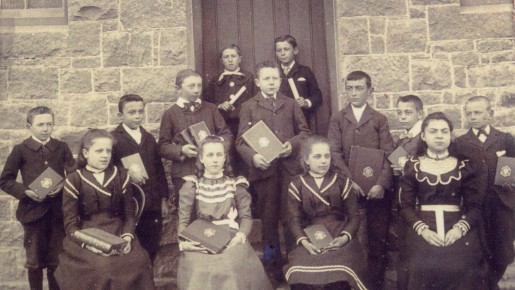
Trinity School winners of States' Prizes for French, 1899, incl. Edmund Blampied (second row, second from right)
Ernest John Gruchy was Headmaster of Trinity School for four decades, from 1884 to 1927, which included the years when Blampied was a pupil. Within ten days of his appointment as Head, Gruchy recorded that the school was “backward in all subjects” and promptly reorganised the timetable and curriculum. In 1892, he introduced ‘vertical writing’ and refined teaching in reading, arithmetic and French. Arguably one of his most significant innovations came on 4 August 1891, when the school “began teaching Drawing according to Science and Art Syllabus”.
The subject proved difficult at first. By October 1891, Gruchy noted “great difficulty found in the teaching of Drawing”, and by March 1892, it was “not advancing sufficiently”. However, persistence paid off and by the 1898 school inspection, it was reported that “Drawing is good”.
This early exposure to formal art instruction may well have helped to shape Blampied’s love of the subject and to develop his artistic abilities. His two battle scenes show a high level of skill for a boy of 13.

1898 inspector's report described drawing as 'good'.
For a century, Blampied’s two school drawings remained with the family of Gruchy, who reportedly showed them to his wife, Julia, who had trained at the Slade School of Fine Art. She is said to have remarked that they were “very good for a boy of his age” and that Blampied should be encouraged and have further teaching.
This encouragement – along with a visit to the studio of John Helier Lander in 1899 – may have inspired Blampied to take art more seriously. Further guidance came from Marie Josephine Klintz, a French-born drawing teacher, who ran a small private art school in St Helier. Klintz offered Blampied art lessons after noticing some of his drawings at the Royal Jersey Agricultural & Horticultural Society in 1902. In her art classes, she introduced Blampied to watercolour and formal instruction.
Blampied’s caricatures of local politicians attracted the patronage of Saumerez Nicolle, who sponsored his studies at a local art school until he could compete for a scholarship. In 1903, he enrolled at the Lambeth School of Art in London – a daunting move for a boy of 16 who, as a native Jèrriais speaker, spoke little English.

Aliens card of Marie Josephine Klintz
Blampied went on to enjoy an internationally acclaimed career as an illustrator, etcher and lithographer, producing works for books and magazines, including illustrations for J M Barrie’s ‘Peter Pan and Wendy’, and exhibiting widely across Europe and beyond.
However, Blampied is best remembered for his depictions of Jersey life. His rural upbringing had an enormous influence on his output as an artist, and he captured the world that he saw around him in his work. In drawings, watercolours, oil, print, sculpture and more, Blampied illustrated almost all aspects of Jersey life, including men and women at work and play, vraicking scenes, potato planting, cider production and animals working. The large body of work he left behind after his death in 1966 provides a rich insight into life in Jersey in the first half of the 20th century.

Never Never Land' for 'Peter Pan and Wendy', 1939
It is possible that this successful career all started at Trinity School. Though the name ‘Edmund Blampied’ never appears in the Trinity School logbook, an entry dated 2 March 1932 refers to a visit by “Mr Edwin Blampied, R.A., an old Trinity School boy”. Although the postnominals ‘R.A.’ denote membership of the Royal Academy of Arts, Blampied was never actually elected to the Royal Academy and instead used the initials ‘R.E.’, applied by Fellows of the Royal Society of Painter-Etchers and Engravers, as it was known then. He was also a Fellow of the Royal Society of British Artists (RBA). Despite these inaccuracies in the register, it still seems likely that the entry did indeed refer to Edmund, returning to the place where his talent was first recognised.

Visit of 'Edwin' Blampied RA, an old Trinity School boy' in March 1932