
Featured Purchase Your Heritage Pass
February is the time of year when farmers were legally able to cut vraic (seaweed) on the beach to fertilise their fields. Find out more about this activity and how it still has an impact on our historic environment today.

Traditionally, these huge and hearty buns were taken by farmers and their families to the beach to enjoy whilst collecting vraic. No doubt the salty sea air added to their flavour.
Ingredients
1lb plain white flour
1tsp grated nutmeg
1tbsp dried yeast
2oz caster sugar
¼ pint milk and warm water mixed
2 beaten eggs
4oz unsalted Jersey butter, melted
6oz raisins
Pinch of salt
Method.
Sieve most of the flour into a heatproof bowl, add the nutmeg (or mixed spice if you prefer). Mix.
Put the whole bowl into a warm oven on low heat to slightly warm the flour which will help activate the yeast.
In the meantime, in a small bowl add the yeast and caster sugar and then half of the warmed milk and water mixture. Let the sugar dissolve and stir to begin activating the yeast.
Take the warm flour from the oven, make a well in the centre and add the yeast/sugar mixture. Lightly sprinkle some of the remaining flour over the top. Leave in a warm place for 20 minutes, covered with a cloth.
In the meantime, toss the raisins in the remaining flour to coat them.
After 20 minutes, add the raisins, beaten eggs, melted butter, salt and remaining milk/water to the warmed flour.
Mix and then knead to form a firm dough. Divide the dough into eight bun shapes and place on a baking sheet lined with greaseproof paper sprinkled with flour.
Leave to prove for 10-15 minutes in a warm place covered with a cloth.
Cook in a preheated oven at gas mark 6, 200˚C, 180˚ fan.

Best enjoyed warm, slathered with Jersey butter. Yum!
Why are Jersey’s slipways so uneven?
…to stop your horse and cart from slipping as they pull a heavy load of vraic off the beach, of course!
The Island’s slipways were originally built in each parish principally to allow access to the shore to gather vraic (seaweed), and to launch a small boat. The granite setts (stones) were traditionally laid at a raked angle to provide a firmer footing for people and to prevent cartwheels and hooves from slipping.
Outside of harbours, they weren’t constructed until the threat of French invasion had passed as they would have been an ideal landing point for troops. A handful of slipways are shown on the 1849 Godfray map, but most date from the mid-19th century to the early Edwardian period.
Find out more on the Historic Environment Record.

Discover some of the history of vraicking, learn where the vraic was collected and why. Find out what it means when a rock has a ‘P’ etched coarsely on it.

These amazing images from the Jersey Evening Post Photo Archive show vraic being gathered from beaches around the Island by farmers to be put on their Jersey Royals crop as fertiliser. See more images from the JEP collection, held at Jersey Archive here.
The traditional nickname for people from Grouville and St Clement is “Les Enfeuntchis” (smoky ones) as the custom of burning vraic for ash fertiliser along the coasts meant that farmers coming from those parishes into Town for the markets retained the smoky smell on their clothes from having passed the fires. However, “Enfeuntchi” (smoked up) has a double meaning as if your head is full of smoke, you were regarded as a dimwit.
It’s the time of year when farmers were legally able to cut vraic (seaweed) from the beach – but collection could not begin until a vraic marker, lé mèr, was uncovered by the sea.
In the past, vraic collectors would follow the tide out with their carts and patiently wait for the markers and their day’s harvest to be revealed by the falling tide.
Have you ever spotted one of these markers while out on the beach?…
Please make sure you explore Jersey’s intertidal zone safely – always check tide times, charge your phone and tell a friend where you’re going.
Collecting vraic was hard work! To cut and gather the seaweed off the rocks and pile it up, either on the beach or on the back of a vraicking cart, you needed specific tools, such as this large, fearsome looking four-pronged fork from our collection, being held by one of our Site Gardiens, Chris Bentley.

Vraic fork
The other tool frequently used was a sickle-like vraic cutter.
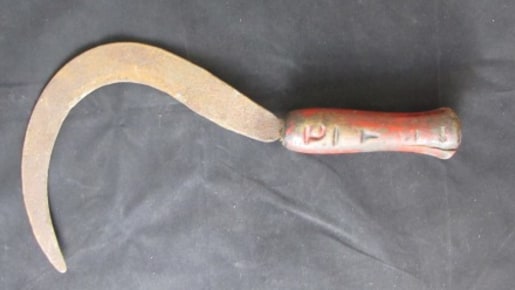
Sickle-like vraic cutter